
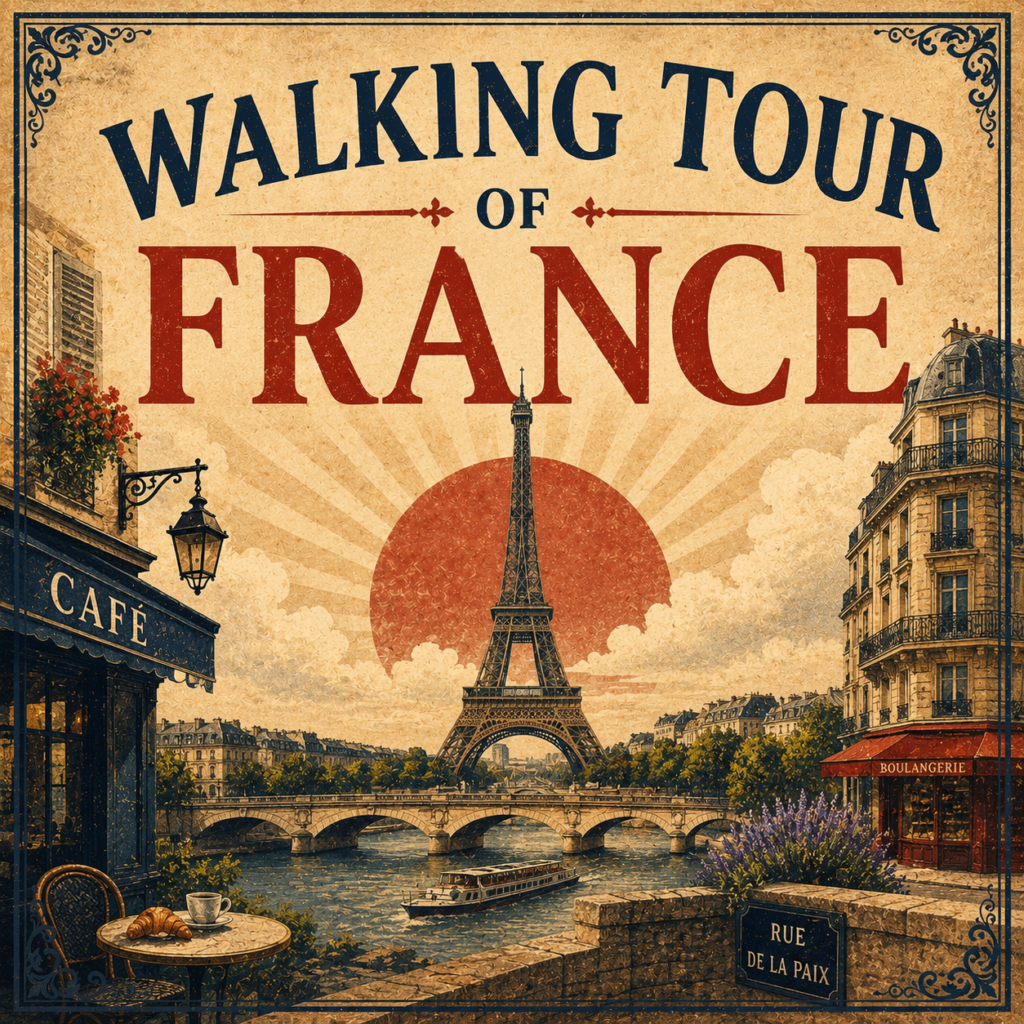
The Eiffel Tower is more than a postcard. Standing on the Champ de Mars in Paris’s 7th arrondissement, it is the most visited paid monument on earth — welcoming nearly seven million visitors annually — and one of those rare structures that has earned its place at the center of an entire civilization’s imagination.
A Monument Born from Controversy
The tower’s origins are rooted in ambition. For the 1889 Exposition Universelle — the great World’s Fair that celebrated the centennial of the French Revolution — the city of Paris sought a centerpiece unlike anything the world had seen. A competition produced hundreds of proposals, and the winning design came from the firm of engineer Gustave Eiffel, whose team of engineers and an architect named Stephen Sauvestre developed the iconic lattice structure.
Construction began in January 1887 with 250 workers and finished a remarkable two years, two months and five days later. Two and a half million rivets hold the structure together. At its completion on March 31, 1889, it was the tallest human-made structure on Earth — a title it held for forty-one years.
The reaction from Paris’s cultural establishment was famously hostile. A group of leading artists and intellectuals published a letter condemning the tower as an iron disaster — “a monstrous iron asparagus” was among the kinder characterizations. Gustave Eiffel responded with equanimity. History sided with him.
Originally intended to stand for only twenty years before demolition, the tower was saved by science. Eiffel actively promoted scientific experiments on and from the structure, including early radio transmission research. By the time its scheduled removal arrived in 1909, the tower had become an indispensable communications mast. It has stood ever since.
Exploring the Tower Level by Level
The Base and Esplanade
Approaching the tower from the Champ de Mars, the first impression is one of scale. The base covers a square measuring 125 meters on each side. Beneath the tower, looking straight upward through the iron lattice, gives a perspective that no photograph replicates.
The First Level (57 meters)
The first floor features a glass floor section — a genuine thrill even for visitors who consider themselves untroubled by heights. Exhibitions on this level tell the story of the tower’s construction and transformation through the decades, with original blueprints and period photographs. The Madame Brasserie restaurant provides a good meal with extraordinary views.
The Second Level (115 meters)
This is where many visitors choose to spend the most time. The panoramic view from 115 meters takes in the full sweep of Paris in every direction — Montmartre and its basilica to the north, the Seine curving through the city, the Invalides to the south, the Arc de Triomphe to the west. A champagne bar at this level offers one of the more memorable ways to take in the view. This level also holds the celebrated Le Jules Verne restaurant, helmed by Michelin-starred chef Frederic Anton, which should be reserved months in advance for a special occasion.
The Summit (276 meters)
Accessible only by elevator from the second floor, the summit provides views extending up to seventy kilometers on clear days. The highlight here is the faithful reconstruction of Gustave Eiffel’s private apartment, where he once hosted Thomas Edison during the 1889 World’s Fair. Edison’s entry in the guestbook — praising Eiffel as the brave builder of a gigantic specimen of modern engineering — captures the spirit of an extraordinary era.
The Tower at Night
Every evening after dark, 20,000 light bulbs illuminate the tower. For five minutes at the top of each hour, a sparkling light show — designed by lighting artist Pierre Bideau and running since 1985 — transforms the structure into something genuinely magical. Watching from the Champ de Mars lawn, surrounded by visitors who have all fallen quiet, is one of Paris’s most beloved experiences.
Practical Tips for Visiting
Pre-booking tickets online is strongly recommended, particularly in summer and during school holidays, when walk-up queues can exceed an hour. The official tower website guarantees the best prices. The tower opens at 9:00 AM in summer and 9:30 AM in winter.
Arriving at opening time or after 9 PM produces the thinnest crowds. The stairs — accessible to the first and second levels — are one of the best-kept secrets of any visit, offering a close encounter with the structure itself and a staircase that is often quieter than the main visitor areas.
The tower is painted every seven years with approximately 60 tons of paint in three subtly different shades of brown-ochre, lighter at the top and darker at the base, a technique that makes the structure appear more slender than it is.
What to Do Nearby
The neighborhood around the tower rewards extended exploration.
The **Trocadero Esplanade**, reached by crossing the Pont d’Iena, offers the classic postcard view of the tower, framed by the grand Palais de Chaillot and the wide reflecting pool. The Cite de l’Architecture within the Palais de Chaillot is among Europe’s finest architecture museums.
The **Musee du Quai Branly** sits just east along the river — a remarkable museum of art and culture from Africa, Asia, Oceania, and the Americas, housed in a stunning Jean Nouvel building with a celebrated living green wall.
The **Musee d’Orsay**, a short walk east, holds the world’s premier collection of Impressionist painting in a magnificently converted nineteenth-century railway station.
Rue Cler, a pedestrian market street a few minutes south of the tower, is one of the best spots in Paris to assemble a picnic: boulangeries, fromageries, wine shops, and fresh produce stalls in an authentically local setting. The Champ de Mars lawn, directly in front of the tower, is the destination.
Where to Eat
La Fontaine de Mars on the rue Saint-Dominique has been a neighborhood institution since 1908. Red and white check tablecloths, dark wood, burgundy bench seats — and a menu of irreproachably classic French cooking: duck confit, cassoulet, sole meuniere, followed by mille-feuille or floating islands. Open daily for lunch and dinner; reservations recommended.
Le Jules Verne on the tower’s second floor offers a Michelin-starred tasting menu experience unlike any other in the world. Book months ahead.
Carette on the Trocadero square is a traditional patisserie and tearoom directly across the Seine from the tower, perfect for morning coffee and a mille-feuille while the light catches the iron.